
The Real IP Isn't the Model
By Lytical Ventures
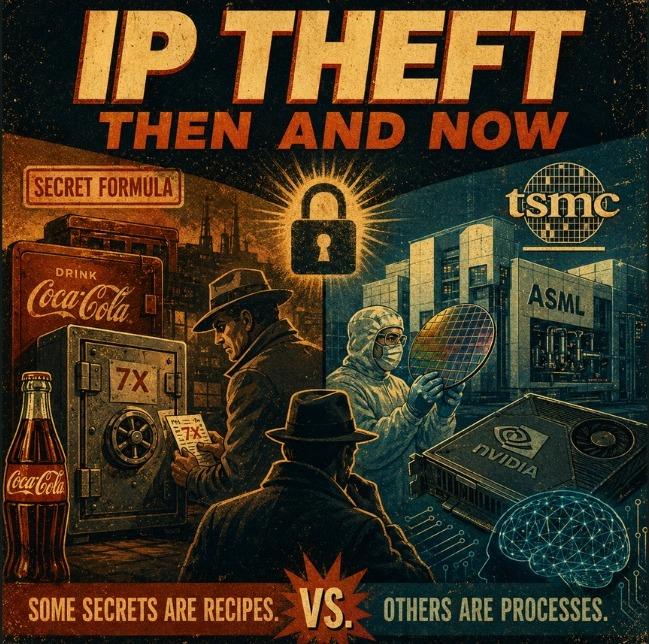
The defensible advantage in frontier AI may not be the weights anyone can copy, but the factory that keeps making the next thing.
Key takeaways
- Coca-Cola's secret formula shows that protecting IP is often about protecting the brand, since the recipe itself has almost certainly been reverse engineered.
- TSMC's moat is not its chips, which can be reverse engineered, but the roughly $200 million ASML EUV machines and years of process tuning that drive yields.
- Distillation, which xAI admitted using with OpenAI models to train Grok and which Chinese labs are suspected of using, lets rivals imitate any model exposed through an API.
- For frontier AI labs the durable IP may be the process: the leading labs already use their next model internally to build the one after it, a compounding advantage nobody outside sees.
- If that dynamic holds, the real moat in AI is the factory, not the weights.
IP Theft Then and Now.
The value of intellectual property has always mattered and historically companies have gone to extraordinary lengths to protect it, even when the underlying product could eventually be reverse engineered.
Take Coca-Cola and the "secret formula."
Even though you can analyze Coke with modern chemistry equipment, Coca-Cola still fiercely protects the recipe. The formula itself may not be impossible to replicate, but the idea of the secret formula still has enormous value.
The recipe, often referred to as "Merchandise 7X," has never been publicly confirmed by the company. It is famously said to be known by only a tiny number of people at any given time, and the written formula is reportedly stored in a vault at the World of Coca-Cola museum in Atlanta. Some of that is probably genuine security practice, and some is part marketing mystique.
Fun fact: patents expire after 20 years. Trade secrets can last forever, as long as they remain secret.
Another company could, and almost certainly has, reverse engineered Coke. Heck, the "original recipe" was discovered decades ago in a leather notebook allegedly owned by a friend of Coke’s inventor. But that barely matters because the "secret formula" itself became part of the brand and efforts to preserve the "secret formula" are correctly understood as efforts to preserve the brand, not the formula itself.
THE MODERN VERSION: TSMC
Now let’s talk about a more modern example: TSMC.
While competitors can reverse engineer the chips coming out of TSMC fabs, that is not where the real IP lives. Two things prevent competitors from easily reproducing what TSMC does:
- The tools of creation
- The process itself
The magic tool.
To manufacture sub-5 nanometer chips requires extraordinarily specialized lithography machines. Think of them as darkroom equipment for silicon.
Except that one machine costs roughly $200 million.
These EUV lithography machines are built by the Dutch company ASML. They are the size of a bus, staggeringly complex, and heavily export restricted. One reason Chinese fabs have struggled to catch up to TSMC is that access to these machines is tightly controlled.
Owning the recipe is one thing. Owning the machine that makes the recipe possible is another.
THE PROCESS
But the machines are only part of the moat.
The real IP may be the manufacturing process itself.
Chip manufacturing requires incredibly controlled clean rooms, but that is just the beginning. The harder part is tuning thousands of variables that affect yield rates across wafers. Some chips will always fail. The goal is to maximize how many survive.
By way of example, TSMC's new fabs in Arizona are improving rapidly, but yields still reportedly lag behind those of its Taiwanese facilities. Dialing in those variables over years of iteration is where the real advantage lives.
Rumor has it that SMIC, China's leading semiconductor manufacturer, has aggressively recruited former TSMC engineers in an attempt to close the gap. Stories circulate that some engineers even use pseudonyms internally because of the sensitivity around trade secrets and process knowledge.
IP FOR FRONTIER MODELS
Great history lesson. What's the point?
A few weeks ago Elon Musk admitted in court that xAI used distillation techniques involving OpenAI models while training Grok. Distillation is essentially using one model (say, ChatGPT) to help train another (Grok), and many frontier labs consider it a form of IP theft that violates API terms of service.
Chinese labs are widely suspected of doing the same thing. Some observers believe DeepSeek's rapid progress and low training costs were heavily aided by distillation.
But this raises an interesting question:
How does a frontier AI lab protect its IP when it gives developers API access to the product itself?
One answer is that, much like TSMC, the real IP may not be the model itself. It may be the process used to create the model.
Other labs can imitate currently released models. See DeepSeek, or even xAI. But the leading labs have already built the next model internally, and are using it to help build the next-next model before anyone else ever sees it.
That creates a compounding advantage.
The best models help create even better models. Those models help create the next generation faster still. Over time that gap compounds.
And if that dynamic holds, the real moat in AI may not be the weights themselves.
It may be the factory.
Lastly, if you appreciate our highlights and heresies, follow us on Twitter and LinkedIn, we post regularly about real things worthy of your attention.
Questions this article answers
- What is model distillation and why is it treated as IP theft?
- Distillation uses one model's outputs to help train another, for example using ChatGPT to help train Grok. Frontier labs consider it a violation of their API terms of service because it lets a competitor copy capability without doing the original research.
- How can an AI lab protect its IP when it sells API access to the model?
- By making the released model something other than the real asset. Like TSMC, whose advantage lives in its tools and manufacturing process rather than in its chips, a lab's advantage lives in the process that produces each next model faster than rivals can copy the last one.
- Why does the article compare frontier AI to TSMC rather than Coca-Cola?
- Coca-Cola guards a recipe whose value is mostly brand. TSMC guards a process: export-restricted lithography machines and thousands of tuned yield variables. AI labs look more like TSMC, because their edge compounds through the process of building successive models.